U.S. agriculture is often considered among the best in the world in part due to its culture of continuous innovation.
Institutions like the U.S. Department of Agriculture, land-grant universities and private sector R&D have driven consistent improvements while farmers and ranchers have invested in new technologies.
For instance, farmers now use GPS, drones and satellite imagery to optimize planning, irrigation and harvesting in order to maximize production and minimize resource use. Our crops are more resilient to pests, disease and climate stress, while reducing the need for chemical inputs and increasing food security. Cover crops, no-till farming and other regenerative agriculture practices are being increasingly adopted, which helps improve soil health, reduce erosion and capture carbon. Machine learning tools analyze climate, soil and market data to help farmers make smarter, faster decisions — boosting efficiency and resilience. And U.S. ag is innovating to adapt to changing weather patterns, helping feed a growing global population while reducing emissions. It’s pretty incredible when you think about it.
U.S. agriculture is a global powerhouse not just because of our productivity, but because we continuously adapt to the challenges in front of us.
Thank you for your continued support.
Kevin Burkum
CEO
U.S. Farmers & Ranchers in Action
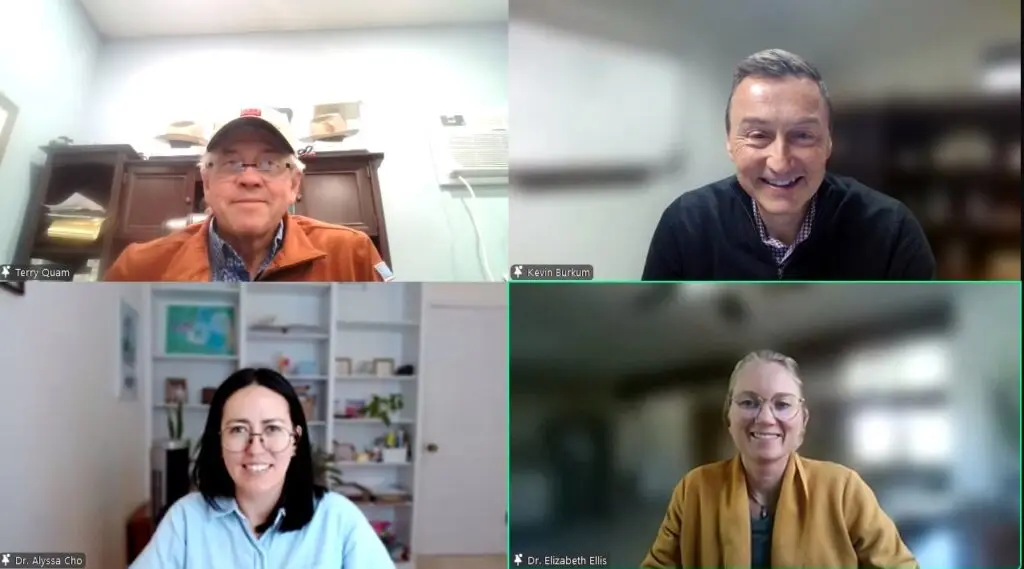
Webinar participants (clockwise from top right): USFRA CEO Kevin Burkum, Dr. Elizabeth Ellis of Colorado State University, Dr. Alyssa Cho of Bayer Crop Science, and farmer Terry Quam of Cattlemen’s Beef Board.
USFRA held the second webinar in a five-part series on May 21 that focused on soil carbon sequestration, one of the key opportunities for agriculture to reduce its carbon footprint while increasing farmer profitability and farm resilience identified in USFRA’s report “Potential for U.S. Agriculture to Be Greenhouse Gas Negative.”
Dr. Elizabeth Ellis of Colorado State University, one of the authors of the soil carbon sequestration chapter of the report, provided a summary of the key findings and reviewed ecological principles of regenerative agriculture that help maximize sequestration. Dr. Keith Paustian, also of Colorado State University and a co-author of that chapter, provided further explanation about factors that affect the potential for sequestering carbon in various regions across the country.
Dr. Alyssa Cho of Bayer Crop Science talked about the commitments companies are making around carbon sequestration in agricultural systems and what this means regarding opportunities for farm revenue through carbon markets. Terry Quam, a Wisconsin beef farmer and member of Cattlemen’s Beef Board, described what his family does to boost soil health and remain profitable while blending cattle and crop farming.
The third webinar in USFRA’s series about opportunities for agriculture to reduce its carbon footprint will focus on the challenges and opportunities in animal protein production. The event is set for June 17 from 2 to 3:30 p.m. CT.
Speakers include Dr. Ermias Kebreab of the University of California-Davis, Dr. Logan Thompson of Kansas State University, Tim Kurt of Dairy Management Inc., and Michael Crinion of Edge Dairy Farmer Cooperative.

USFRA is partnering with Dr. Jerry Hatfield, former USDA-ARS laboratory director, National Laboratory for Agriculture and the Environment, and Dr. Bruno Basso of Michigan State University on a new study on nutrient management.
The research is a follow-up study to USFRA’s “Potential for U.S. Agriculture to be Greenhouse Gas Negative” report, which found that U.S. agriculture, with enhanced implementation of conservation practices and emerging technologies, has an opportunity to more than offset its carbon footprint while increasing farmer profitability and farm resiliency.
The national dairy, soybean, corn and pork commodity organizations have provided invaluable input and feedback on the new research concept, as have a number of USFRA board companies. Findings of this research will be announced at the United Nations Climate Change Conference (COP30) in Brazil later this year.
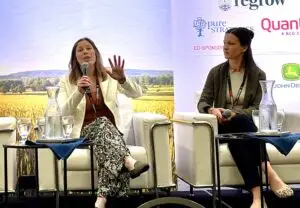
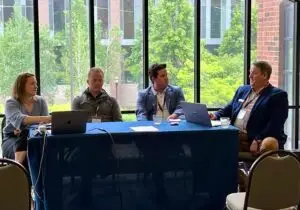
At left: Carla Schultz (left), a Michigan farmer, and Jocelyn Schlichting, who farms in Minnesota, were featured in the opening session of The Future of Food and Beverage USA forum.
At right: USFRA Chair Michael Crinion (right) moderated a discussion about how technology relates to farm resilience.
USFRA and its network helped bring the voice of farmers and ranchers to The Future of Food and Beverage USA forum May 28-29 in Minneapolis.
Chair Michael Crinion moderated a panel discussion about ensuring technology creates farmer resilience instead of dependency, while CEO Kevin Burkum led a discussion on how to optimize strategies in farmer data centralization without compromising farmer autonomy. Also, USFRA worked closely with the Minnesota Corn Growers Associationand the United Soybean Board to bring two of their farmer board members to the conference to participate in the opening session. Jocelyn Schlichting from Minnesota and Carla Schultz from Michigan shared their experiences and insights around regenerative agriculture and the next generation of farmers.
The forum brought together leading brands, farmers, retailers, traders, investors and key stakeholders to identify the main areas of opportunity and innovation within the food and beverage industry.
USFRA’s podcast, Farm+Food+Facts, draws thousands of listeners and is recognized as one of the top podcasts that explore sustainable food systems. This month’s episodes include:
In a Podcast Extra, Dr. Bruno Basso of Michigan State University shares insights on emerging technologies in nitrogen fertilizer management. Listen HERE.
Dr. Elizabeth Ellis of Colorado State University digs into the benefits of carbon sequestration including increased soil carbon, potential crop resilience to weather extremes, decreased energy inputs and improved quality of the grain or forage produced. Listen HERE.
In a Podcast Extra, Dr. Ellis discusses how farmers are increasing soil carbon storage with practices already in place. Listen HERE.
Don’t forget to subscribe and tune in to Farm+Food+Facts!
Important dates:
June 17: USFRA Webinar Series: The Challenges and Opportunities in Animal Protein Production
Oct. 14-15: Transform Food & Agriculture USA 2025
Nov. 10-21: United Nations Climate Change Conference (COP30)