Mobilizing innovation, capital, demand, and partnerships to scale farmer-centered regenerative agriculture.

 London Climate Action Week (LCAW), Climate Innovation Day (CID) STL, and NY Climate Week (NYCW) 2026

Multi-stakeholder discussions from London to St. Louis to New York City

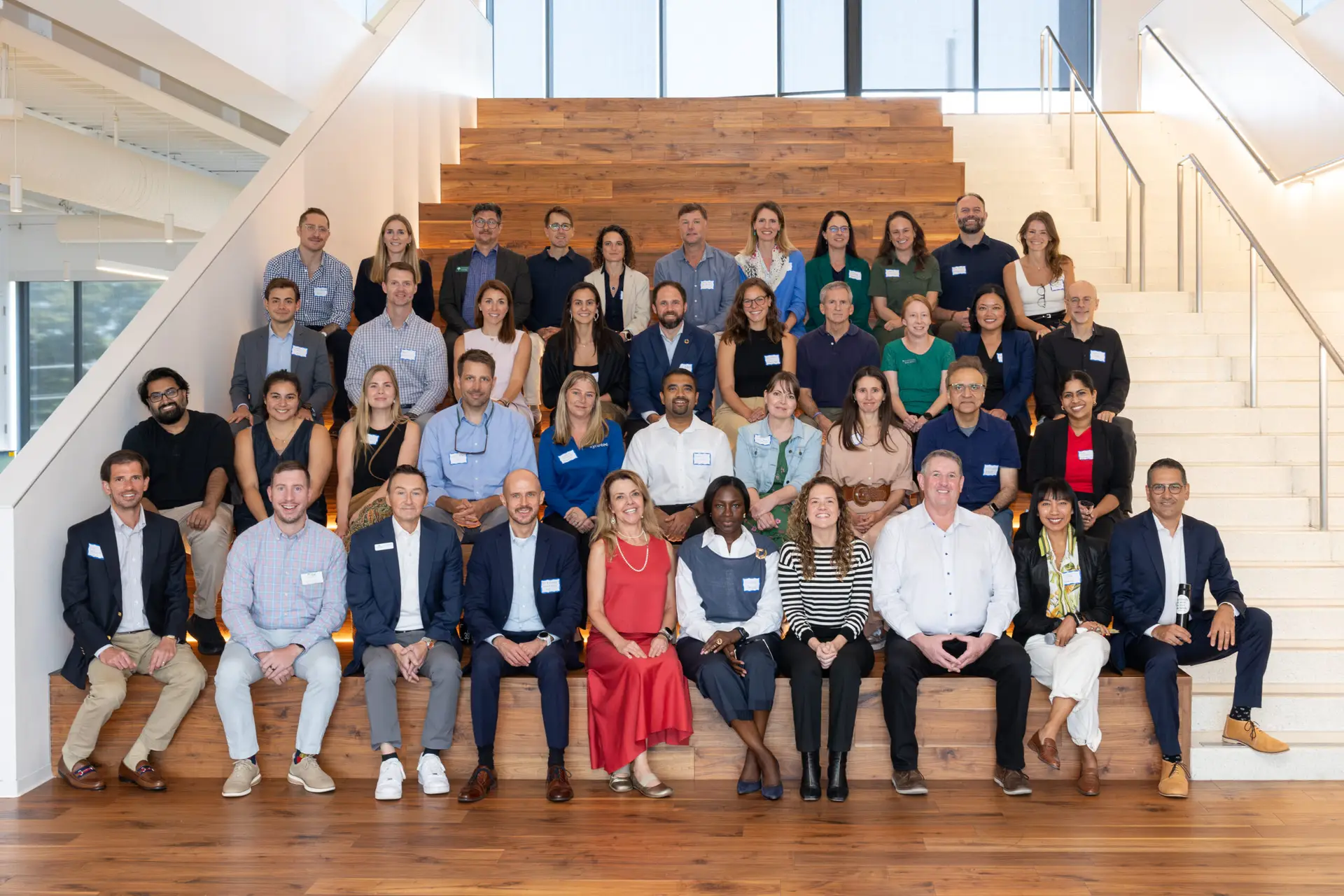
Multi-stakeholder discussions conducted in London, St. Louis (STL) and New York City (NYC) in 2026 is a working dialogue series building on a legacy of convenings, including UN Global Food Systems Dialogues 2020-2021, Climate Innovation Day STL 2024, and Climate Week NYC 2025. Participants included global experts, including farmers, scientists and researchers, philanthropists, investors, and leaders from NGOs and corporations. 

 This report summarizes the 2026 working dialogue series’ background and vision; barriers to success, including three in particular for focus and attention; and high impact solutions and immediate actions developed at CID STL and NYCW 2026.

THE BACKGROUND AND VISION

The challenges of climate change, biodiversity loss, and environmental pollution are expected to intensify in the coming years, and agriculture remains a sector critical for decarbonization. Science and innovation have been leapfrogging in the past decade, and we are now close to having the tools needed to transform the sector: fertilizers decoupled from fossil fuels; practices that lock in carbon and reduce emissions; low-input crops that diversify farm income. Yet the most pressing challenge is no longer innovation – it is making them viable. How do we create the conditions for these innovations to reach farmers, function within markets, and deliver wins across the full value chain?


This series of multistakeholder discussions was set up as one pathway to address these consequential questions and challenges:
  1. LCAW: alignment on the challenge and urgency.
  2. CID: structured problem-solving around three opportunity areas.
  3. NYCW: a smaller value-chain conversation to move promising solutions toward partnerships and commitments.
The process was guided by a shared vision: An agri-food system where climate solutions are economically viable, trusted, scalable, and beneficial for farmers, markets, and society.


SYSTEM-WIDE BARRIERS threaten the Vision
The convening at LCAW identified the following system-wide barriers to scale regenerative agriculture:
  1. Farmers carry disproportionate risk.
  2. Lack of market incentives.
  3. Insufficient trust in science and innovation.
  4. Weak alignment among finance, policy, markets, and implementation actors.
  5. Agricultural innovation is difficult to finance.
  6. Fragmented ecosystem collaboration – value chain coordination is the missing link
  7. Inadequate mechanisms to scale successful pilots.
The group concluded that in order to scale regenerative agriculture, the next convenings should focus on 1) prioritizing 3 investable opportunities, 2) engaging value chain partners, and 3) developing finance-ready propositions. 

THREE OPPORTUNITIES were assessed at CID 2026

Three opportunity areas were identified, and the two-day convening in St. Louis focused on co-designing solutions to address the key barriers for scaling them.


1. Carbon markets
  • Unclear ownership and product definitions.
  • Poor transparency on value and risk allocation.
  • High transaction costs.
  • Limited trust among farmers.
  • Lack of scalable MRV (measurement, reporting, verification).
  • Uncertain profitability.


2. Green fertilizers
  • Weak investment case.
  • Unclear demand durability.
  • Insufficient policy clarity.
  • Challenges identifying economically viable locations.
  • Risk that local production remains too fragmented or costly.


3. Biofuels
  • Food-versus-fuel concerns.
  • Land-use and biodiversity concerns.
  • Need for policy acceptance.
  • Lack of infrastructure and financing.
  • Uncertain customer demand.
  • Need to ensure farmers receive fair value.


SOLUTIONS co-designed by CID participants
  1. Carbon Markets: Create a Buyer-Led Alliance
  • Aggregate buyer demand.
  • Create common quality standards.
  • Establish practical carbon-intensity benchmarks.
  • Scale Measurement, Reporting, and Validating (MRV) systems.
  • Test risk-sharing financial instruments.
  • Build farmer education and engagement programs.


Flagship solution:
Establish a buyer-led facility bringing together buyers, farmers, financiers, and market actors to reduce risk and create stronger demand signals.


  1. Green Fertilizers: Build an Investor-Ready Deployment Model
  • Map low-carbon energy and fertilizer demand.
  • Identify high-potential production locations.
  • Develop standardized project-development toolkits.
  • Combine agriculture demand with industrial and maritime demand where appropriate.
  • Create stronger policy and investment signals.


Flagship solution:
Establish a location-screening model and deployable investment package for low-emission nitrogen production.

3. Biofuels: Develop a Maritime Biofuel Corridor

  • Focus on maritime fuel demand as an initial growth market.
  • Connect farmers, feedstock suppliers, ports, fuel producers, and shipping customers.
  • Create safeguards around food security, biodiversity, and land use.
  • Develop financing and infrastructure pathways.
  • Build farmer-focused support systems and measurement tools.
 
Flagship solution:
Establish a bankable maritime biofuel corridor linking agricultural feedstocks to shipping markets.
 
RECOMMENDATIONS from the Solutions Advisory Committee
 
  • Keep farmers and farm profitability at the center.
  • Design for trust and transparency.
  • Start with specific geographies and value chains.
  • Blend policy, finance, markets, infrastructure, and measurement.
  • Build multi-stakeholder partnerships rather than relying on single organizations
  • Move from dialogue to implementation.
 
IMMEDIATE ACTIONS & RECOMMENDATIONS, from the participants
 
At CID and NYCW participants highlighted potential next steps to advance the three opportunity areas and recommendations to scale up regenerative agriculture in general:
 
  1. Advance each flagship solution
  • Select one pilot.
  • Define a specific geography and use case.
  • Identify a convening organization.
  • Recruit implementation partners.
  • Develop an evidence package.
  • Engage funders, buyers, policymakers, and technical experts.
 
  1. Promote progress, event-to-event
  • Develop solution pathways during Climate Innovation Day.
  • Stress-test them through the VIP Roundtable.
  • Advance strongest ideas at Climate Week NYC.
  • Build long-term partnerships, regional implementation and engaging at each summit.

3. Cross-cutting insights for scaling regenerative agriculture

  • Farmer-centered transition economics; Adoption depends on the economic viability for producers.
  • Data clarity, consistency, and inclusive infrastructure; Better data and MRV approaches are needed, but systems must be usable by farmers, reduce fragmentation and return value to those generating the data.
  • Demand and offtake signals matter; Procurement, sourcing, buyer aggregation and market design can create the pull needed to reward lower-carbon and regenerative production beyond time-bound transition programmes.
  • Shared financing, policy and partnerships are essential; Value chains, governments, producers and buyers should be positioned as partners in reducing early-stage costs, improving conditions for investment and building credible pathways to scale.
 
GOALS ACROSS STAKEHOLDER GROUPS to advance the vision
 
  1. For farmers
  • Stronger and more diversified income streams.
  • Reduced adoption risk.
  • Better access to climate-smart technologies.
  • Greater participation in environmental markets.
  • Increased resilience and profitability.
 
  1. For agriculture
  • Faster scaling of regenerative and climate-smart practices.
  • Greater adoption of low-emission fertilizers.
  • Expansion of sustainable biofuel value chains.
  • More credible agricultural carbon markets.
 
  1. For climate and environment
  • Lower agricultural greenhouse-gas emissions.
  • Improved soil carbon sequestration.
  • Reduced dependence on fossil-fuel-derived inputs.
  • Better management of biodiversity and land-use impacts through designed safeguards.
 
  1. For society and markets
  • More trusted and resilient food systems.
  • Increased public confidence in agricultural innovation.
  • Stronger collaboration between business, government, science, and civil society.
  • Market systems that reward both economic and environmental performance.
 
 
ACHIEVING THE VISION requires creating the market, financial, policy, and partnership conditions that allow agricultural innovations to scale, enabling farmers to prosper while accelerating climate resilience, decarbonization, and better food systems for all.
Mobilizing innovation, capital, demand, and partnerships to scale farmer-centered regenerative agriculture.
Climate Innovation Day (CID) STL and Climate Week NYC (CWNYC) 2026
APPENDIX
Summary report
CID STL mini-design sprint recommendations, September 18
3 opportunities brought to the Roundtable Dialogue, NYCW September 22
From Proof to Scale – Financing Resilient Agriculture Together, NYCW, September 22 Speakers
CLIMATE INNOVATION DAY
September 18, 2026
Hosted by 39 North, St. Louis
TWO-HOUR MINI DESIGN SPRINT RECOMMENDATIONS

Three parallel challenge tracks, each focused on a specific innovation opportunity:

  1. Carbon markets
  2. Locally produced, low-emission fertilizers
  3. Biofuel feedstocks
 
Each group addressed four phases.
  1. Map the barriers to scaling up the innovation.
  2. Converge on one concrete problem to solve.
  3. Sketch solutions and dot-vote to choose a single path forward.
  4. Build that solution into a one-page canvas addressing the source of capital, partners, and 6-12 month next steps needed to make it bankable.
 
Result: Preparation for VIP Roundtable at CWNYC.
  • A starting point for investable pathways that are carried forward to VIP Roundtable, Climate Week NYC, Regen House, September 22: From Proof to Scale – Financing Resilient Agriculture Together.
 
  1. Carbon Markets: Build Trust, Simplicity, and Scale
Strategic Challenge The group aligned around a central question: How might we de-risk carbon markets across the entire value chain? From farmers and project developers to financiers and buyers, risk and complexity remain major barriers to participation.
Key Insights
  • Carbon markets need to become simpler, more transparent, and more trusted.
  • Farmer profitability must remain at the center of market design.
  • Consistent measurement and clear value signals are essential to increase participation and investment.
  • Education remains a significant gap, with many agricultural stakeholders still lacking a clear understanding of how carbon markets function.
Priority Opportunities
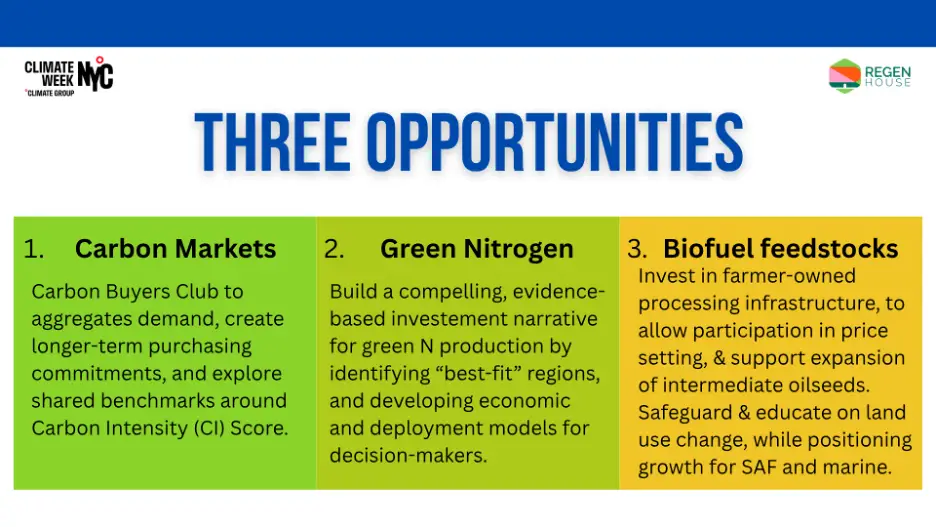
  • Establish a Carbon Buyers Club that aggregates demand and creates longer-term purchasing commitments.
  • Develop innovative financing and insurance mechanisms to reduce risk exposure.
  • Use Carbon Intensity (CI) Scores as a common benchmark to simplify market participation and support standardization.
  • Create a multi-stakeholder alliance bringing together buyers, growers, financiers, and technical experts.
6-12 Month Actions
  • Pilot a Buyers Club with committed offtakers.
  • Test financing models linked to carbon intensity metrics.
  • Expand the use of carbon intensity scoring across additional geographies.
  • Conduct a value-chain assessment to identify risks, returns, and trust gaps.
Executive Message The future of carbon markets depends less on creating new credits and more on creating credible, transparent, farmer-focused systems that attract buyers, investors, and long-term participation.
 
  1. Green Fertilizers: Create a Clear Investment Story
Strategic Challenge The group focused on: How might we drive significant near-term investment in green nitrogen solutions that meet local needs while reducing emissions?
Key Insights
  • Technology is advancing faster than investment.
  • The investment case for green nitrogen is not yet clearly articulated.
  • Policy clarity and stable demand signals are the most important market enablers.
  • Energy security concerns and geopolitical volatility are creating a window of opportunity for localized fertilizer production.
Priority Opportunities
  • Build a compelling, evidence-based investment narrative for green fertilizer production.
  • Identify “best-fit” regions where energy availability, government support, demand, and security needs align.
  • Leverage growing maritime demand for green ammonia as an additional driver for scale.
  • Develop replicable deployment models or “playbooks” that investors and communities can adapt locally.
6-12 Month Actions
  • Conduct regional analyses linking renewable energy availability with fertilizer demand.
  • Develop economic models demonstrating business viability.
  • Identify pilot locations in Africa, North America, and other strategic regions.
  • Create a practical blueprint that investors and local leaders can use to accelerate deployment.
Executive Message The question is no longer whether green nitrogen is technically possible. The challenge is creating the market, policy, and investment conditions that make it commercially attractive and scalable.
 
  1. Biofuels: Unlock Maritime Demand as a Growth Market
Strategic Challenge The sprint examined how biofuels can create new market opportunities while ensuring farmer value, sustainability, and social acceptance.
Key Insights
  • The maritime sector represents a major near-term opportunity.
  • Existing technologies and feedstocks can support significant growth without waiting for future breakthroughs.
  • Success will depend on addressing concerns around food versus fuel and land-use change.
  • Infrastructure and financing, rather than technology, are the primary barriers.
Priority Opportunities
  • Position maritime shipping as the first large-scale market for agricultural biofuels.
  • Expand education and communication around food, fuel, and sustainability trade-offs.
  • Ensure farmers capture value throughout the supply chain.
  • Use biofuel infrastructure investments as a foundation for future sustainable aviation fuel and other low-carbon fuel markets.
6-12 Month Actions
  • Engage the International Maritime Organization and key shipping stakeholders.
  • Develop financial models demonstrating economic viability.
  • Launch education initiatives on food-versus-fuel and land-use concerns.
  • Advance planning for fuel storage, transportation, and port infrastructure.
Executive Message Biofuels can provide a practical, near-term pathway to decarbonization while creating new farmer revenue streams, provided sustainability concerns are proactively addressed and market demand continues to strengthen.
 
Overall Executive Conclusion
Across all three sprints, a common theme emerged:
Innovation is not the primary constraint. Market creation, financing, trust, and coordination are.
Participants consistently emphasized the need to:
  • Keep farmers at the center.
  • Build trust through transparency and education.
  • Create clear demand signals.
  • Mobilize blended finance and investment.
  • Move from discussion to implementation through flagship initiatives.
 
The consensus was that agriculture has an opportunity to lead climate solutions, but success will depend on demonstrating practical, investable pathways that deliver economic value alongside environmental outcomes. The proposed flagship opportunities in carbon markets, green fertilizers, and biofuels provide tangible platforms for action as discussions continue through Climate Week, COP processes, and future multi-stakeholder collaborations.
Illustration: 3 flagship opportunities brought to the Roundtable Dialogue, NYCW September 22
Mobilizing innovation, capital, demand, and partnerships to scale farmer-centered regenerative agriculture.
 VIP Multi-stakeholder Roundtable
Regen House, Climate Week NYC
September 22, 2026

FRAMING QUESTION

How can farmers, innovators, value-chain partners, investors, and enabling institutions combine science, capital, market signals, and shared-risk mechanisms to move proven agricultural solutions from pilot to scale?
ROUNDTABLES were assigned to identify next steps.
Identify next steps to scale resilient and productive agricultural systems.
  • Focus on farmer viability, science-based innovation, bankable opportunities, credible demand, shared-risk mechanisms, and accountability across the value chain.
  • Include farmers, investors, philanthropists, NGOs, and corporations at every table.
 
ROUNDTABLES identified four foundations for success.
To move agricultural transition efforts from proof points to scalable, durable market systems.
  1. Apply farmer-centered transition economics. Adoption depends on economic viability for producers: transition costs, price premiums, practical support, and market certainty must work at farm level.
  2. Establish data clarity, consistency, and inclusive infrastructure. Better data and measurement/monitoring, reporting, and verification (MRV) are fundamental. Systems must support use by farmers, reduce fragmentation, and return value to those generating the data.
  3. Demand and offtake signals matter. Procurement, sourcing, buyer aggregation, and market design can ensure that transition programs become sustainable in the long term. Rewarding lower-carbon and regenerative production will be essential.
  4. Establish foundations of shared financing, policy, and partnerships. Value chains, governments, producers, and buyers were repeatedly positioned as partners in reducing early-stage costs, improving conditions for investment, and building credible pathways to scale.
 
ROUNDTABLE reporters summarized recommendations from each table.
 
1. Biofuels, Tables 1-3
Table 1
  • Market signals are required to sustain the model beyond transition programs.
  • Procurement and sourcing mechanisms will make regenerative outcomes commercially meaningful. As she put it: “show me the market.”
Table 2
  • The gap between production standards and downstream market pathways must be addressed.
  • Regenerative organic production must be certifiable.
  • Retail markets must recognize and reward regenerative organic production.
Table 3
  • Financing is required to promote smallholder resilience, especially during the transition.
  • US producer data must be more cohesive; presently, it is fragmented and not flowing back effectively.
  • Must create a more connected system that supports producer decision-making and resilience.
  • Requirements across the 45Z clean fuel production credit and Scope 3 must be made consistent. (Similar to nitrogen efficiency, payment-for-practice models, and the need for market pull to reward participation.)
 
2. Green Nitrogen, Tables 4-5
Table 4
  • Energy costs and wider renewable-energy and system transformation shape the economics. That is, green nitrogen (produced via renewable-powered electrolysis) currently carries a premium, often costing roughly twice as much as conventional fossil-fuel-derived (gray or blue) nitrogen due to high initial capital costs for electrolyzers and renewable energy integration.
  • To bolster the case and enable adoption, draw on evidence, demonstrations, and farmer–private–public partnerships.
Table 5
  • Impediments must be addressed, including the lower-carbon fertilizer price premium, the technical-assistance and knowledge gap, and the role of time-limited corporate transition financing.
  • Policy, regulation and market creation are seen as complementary conditions for a viable transition.
 
3. Carbon Markets, Tables 6-7
Table 6
  • Emerging market agribusinesses are operating without carbon credit revenue.
  • Recommendations included Buyers Club aggregation, greater price consistency, reduced MRV costs, and aligning approaches with government.
Table 7
  • High costs and a difficult financing cycle are impediments; presently only a small existing Buyers Club.
  • Recommendations included collaboration and long-term financing, with biodiversity and other co-benefits valued alongside carbon.
 
CONVERGENCE ON ACTION FOR NEXT STEPS
A speaker from international organization for public-private cooperation summarized four fundamental aspects for success.
  • Build data infrastructure that is inclusive and delivers benefits to farmers.
  • Reduce transition costs through value-chain cost sharing, government–producer–buyer arrangements, and enabling regulations.
  • Create greater clarity on the carbon-market and Buyers Club model.
  • Strengthen demand signals and support the decommodification of agriculture.
The wider reflection connected policy with offtake demand, particularly the certainty of corporate offtake. Participants also returned to the cost of capital—especially in emerging markets—and to the principle that capital is competitive. In that context, certainty, shared risk and credible market demand were presented as central to unlocking investment.
A speaker from alliance of agricultural organizations and corporate agribusiness interests placed farmer-centricity and economic viability at the center of the transition. Their perspective linked cost reductions and collective collaboration with markets that motivate production. They captured the core constraint: “You can’t be green when you’re in the red.”
 A speaker from an international business coalition focused on the valuation of climate and nature physical risk, including the opportunity to shift losses into resilience investments. They highlighted aggregated private-sector advocacy, matching public funds, a solutions-oriented mindset, and fair allocation of value to farmers.
 
Action steps
  • Establish more consistent, usable data, and MRV approaches that work for farmers and across MRV requirements.
  • Strengthen demand signals and corporate or value-chain offtake for transition outcomes.
  • Co-finance early transition costs through value chain mechanisms and public policy support.
  • Expand technical assistance and field demonstrations to address knowledge gaps and build evidence.
  • Explore scalable Buyers Clubs and approaches that value biodiversity and other co-benefits alongside carbon.
  • Improve physical risk valuation and the cost-of-capital conditions that shape investment, particularly in emerging markets.
 
Closing Note
Discussions emphasized farmer-centered, market-backed and collaborative pathways from pilots to scale. Progress will depend on connecting practical farm economics with consistent infrastructure, credible demand, coordinated financing, policy, and partnership models.

SPEAKERS – CLIMATE INNOVATION DAY STL 9.17.26-9.18.26

William Acree, Washington University St. Louis
Senni Alho, Clim-Eat
Gabriela Burian, Bayer
Kevin Burkum, U.S. Farmers & Ranchers in Action (USFRA)
Dan Christensen, PepsiCo
Dhanush Dinesh, Clim-Eat
Natasha Santos Eastwood, Bayer
Christa Essig, World Business Council for Sustainable Development (WBCSD)
Francisna Kris Fernando, World Bank Group
Renata Ferreira, Bayer
Mike Graham, Bayer
Jim Hedges, CoverCress
Chris Henry, Viridian Ecosystems
Trey Key, Gates Foundation
Alice Korngold, A Better World, Inc.
Bernhard Kowatsch, World Food Programme
Lucia Lohmann, Missouri Botanical Garden
Emily Lohse-Busch, 39 North
Juliana Lopes, World Business Council for Sustainable Development (WBCSD)
Maggie McCoy, Missouri Botanical Garden
Maria Menin, Bayer
Dmitri Nusinow, Danforth Center
Giles Oldroyd, Danforth Center
Mildred Pita, Bayer
Stephanie Regagnon, The Yield Lab Institute
Chelsey Robinson, Bayer

 
Speaker lists from the London Climate Action Week and New York Climate Week 2026 convenings are not included, as both were held under the Chatham House Rule.